
India's Central government is likely to see its fertiliser subsidy bill double to a record 3.4 trillion in FY27, up from the Budget estimate of 1.7 trillion, due to surging global fertiliser prices exacerbated by the West Asia war. This significant increase, coupled with revenue losses from excise duty cuts for oil-marketing companies, is straining the government's fiscal space, though capital expenditure plans remain unchanged.
However, growth is expected to bounce back to an average of 7.3 per cent in the second half of 2017 and 7.7 per cent in 2018

India's GDP had recorded 7.5 per cent growth in the April-June quarter of last fiscal.

Economic growth slipped to a nine-year low of 6.5 per cent last financial year, but India Inc fears further deceleration in the GDP expansion during 2012-13, shows a survey.
The Reserve Bank of India on Wednesday retained the economic growth projection for the current financial year at 10.5 per cent, while cautioning that the recent surge in COVID-19 infections has created uncertainty over the economic growth recovery. In its last policy review, the RBI had projected a GDP growth rate of 10.5 pc for FY'22. Taking various factors into consideration, it said, "the projection of real GDP growth for 2021-22 is retained at 10.5 per cent consisting of 26.2 per cent in Q1, 8.3 per cent in Q2, 5.4 per cent in Q3 and 6.2 per cent in Q4."
Further, the agency said it expects signs of a pick-up to emerge in the second half of the year.

Adani Properties has emerged as the largest value creator in the 2026 Grohe-Hurun India Real Estate 150, adding Rs 38,000 crore in valuation to become India's fourth-most valuable real estate company, with its valuation rising 72.5 per cent year-on-year to Rs 90,400 crore.

The aggregate net worth of the country's 176 dollar billionaires dropped to $984.2 billion during 2025, down from a record $1,036.2 billion at the end of December 2024.
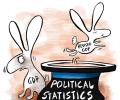
The Economic Survey 2022-23 (FY23), to be presented a day before Union Budget 2023-24 (FY24), is likely to project India's real gross domestic product (GDP) growth between 6 per cent and 7 per cent for FY24, Business Standard has learnt. The broader theme of the Survey could be on how India has dealt with two years of a global pandemic and the ongoing geopolitical disturbance, the strengths and weaknesses that emerged, and what lessons may be learnt. The much-awaited Survey will be the first one by Chief Economic Advisor V Anantha Nageswaran and his team in the finance ministry's economic division.
Moody's Investors Service on Friday slashed its estimate of India's GDP growth during the 2020 calendar year to 2.5 per cent from an earlier estimate of 5.3 per cent, on account of the rising economic cost of the coronavirus pandemic.
The Reserve Bank of India on Wednesday hiked the expected GDP growth for the year ending March 31, 2007 to 8.5-9 per cent.
The government on Tuesday projected a higher economic growth of 8.1 per cent for this fiscal from 7.5 per cent in 2004-05, far exceeding expectations of the finance ministry and Reserve Bank of India.
The brokerage said the consolidated fiscal deficit, including that of the Union (3.6 per cent), the states (2.6 per cent) and the off-budget borrowings which are being resorted to increasingly is a worry.
Economic think-tank National Council of Applied Economic Research expects India's Gross Domestic Product growth to decelerate to 8.3 per cent during current fiscal
India can withstand a possible short war over Iraq but a prolonged conflict may dampen growth prospects, says a Confederation of Indian Industry study.

'You have to get private investment to somewhere between 35% to 36% of GDP. It is hovering about 30%-31%.'

India's new national accounts will leverage new data sources and surveys to enhance the measurement of the country's informal economy, and introduce double deflation methods across sectors, replacing the current system that relies on a single deflation mechanism in Gross Domestic Product (GDP) calculations.

India's services sector growth slowed in March, reaching a 14-month low, according to the HSBC India Services PMI. The slowdown reflects weaker new business intakes and rising input costs, particularly in fuel, transport, and logistics.

The Asian Development Bank too had projected Indian's economic growth for current fiscal at 7.4 per cent.

The BJP still does not have a majority in Upper House of Parliament, the Rajya Sabha, and this will pose hurdles to the party's legislative reform agenda

The Indian economy grew by 4.7 per cent in the April-June quarter last year and the growth rate was also 4.7 per cent for full 2013-14.
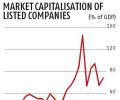
Forty years ago, the total market capitalisation of listed companies in the Indian stock market stood at a paltry seven per cent of gross domestic product (GDP). In 2012, the figure stood at 68 per cent.

The World Bank on Tuesday raised India's growth forecast for the current fiscal to 6.5 per cent from 6.3 per cent estimated earlier, and said the country is expected to remain fastest-growing major economy, underpinned by continued strength in consumption growth.

Indian benchmark indices, Sensex and Nifty, saw early gains driven by lower crude oil prices and buying in Reliance Industries, even as the Reserve Bank of India maintained its benchmark policy rate for the fourth consecutive meeting, reinforcing confidence in the domestic economy.
India's services sector experienced a slight moderation in growth during February, according to the HSBC India Services PMI Business Activity Index, with new order growth slowing and inflation picking up.

The challenge thrown by the youth movement creates the opportunity for a more consequential debate on India's economic trajectory because it must remain centered on India's youth as its driving impulse, asserts former foreign secretary Shyam Saran.

For the time being, the RBI is done with the cuts. A cut in October, which many are still predicting, is not certain. Of course, if growth nosedives, the script will be different, expects Tamal Bandyopadhyay.

'Wages have not risen. Rural wages have stagnated. The growth was 0.7 per cent last year. For casual and irregular labour, the wage growth is negative.'
As he projected a grim outlook for the economy, RBI Governor said that amidst this encircling gloom, agriculture and allied activities have provided a beacon of hope on the back of an increase of 3.7 per cent in foodgrains production to a new record.

'A balance had to be struck between the economic cost of taking action at this point against the need not to fall behind the curve in controlling inflation and anchoring inflation expectations.'

Most members of the Reserve Bank of India's Monetary Policy Committee (MPC) expressed concerns about inflation becoming generalised and highlighted uncertainties surrounding both inflation and growth prospects due to the West Asia conflict, according to the recently released minutes.

Morgan Stanley says, India will clock 7.9 per cent GDP growth in current fiscal.
The Indian economy grew by 4.5 per cent in the October-December period of the current financial year, pulled down by poor performance of farm, manufacturing and mining sectors.

The key question is how much of the latest growth record represents recovery from the 2020-2021 downturn, and what is the sustainable growth rate now, asks T N Ninan.

Fitch Ratings on Thursday cut India's GDP growth estimate by 10 basis points to 6.4 per cent for the current fiscal, but retained the projections for the next financial year, on concerns over a 'severe' escalation in global trade war. "It is hard to predict US trade policy with any confidence. Massive policy uncertainty is hurting business investment prospects, equity price falls are reducing household wealth, and US exporters will be hit by retaliation," Fitch said in its special update to quarterly Global Economic Outlook (GEO).

The Economic Survey on Thursday projected the GDP growth in the range of 6.8 to 7.2 per cent in 2026-27, a tad lower than 7.4 per cent estimated in the current fiscal.

Beside manufacturing, deceleration was also witnessed in sectors like agriculture, construction and electricity, gas and water supply.

The country's gross domestic product (GDP) growth is likely to be 8.8 to 9 per cent in the current financial year, driven by agriculture and industry sectors, Care Ratings said in a report. The country's economy had contracted by 7.3 per cent in fiscal 2020-21. The agency said the outlook for the Indian economy on almost all counts in FY22 would look seemingly better than FY21 on account of the negative base effect.

Consequently, corporate India had shown downfall in terms of net profit margin in the fourth quarter of the financial year 2012-13.

Nomura has increased its March 2027 target for the Nifty 50 to 25,900, driven by strong corporate earnings and attractive market valuations, even as risks from the West Asia conflict and high oil prices persist.
